Organic Search Performance and Competitive Analysis dashboard view

Organic Search Performance & Competitive Analysis

A structured, data-driven evaluation of how your business actually competes in Google β€” against real competitors, across real search demand.

Why This Exists

SEO decisions often rely on incomplete visibility.

You might know your rankings. You might know your traffic. But neither fully answers the question that matters most:

Where do you stand relative to competitors β€” across the keywords that actually drive your market?

Organic search is not measured in isolation. It is measured in position, competition, and opportunity. This analysis removes guesswork by mapping your visibility directly against competitors β€” keyword by keyword, signal by signal.

Request Competitive Analysis β†’

What This Analysis Evaluates

Your performance is analyzed across the core signals that define competitive visibility in organic search:

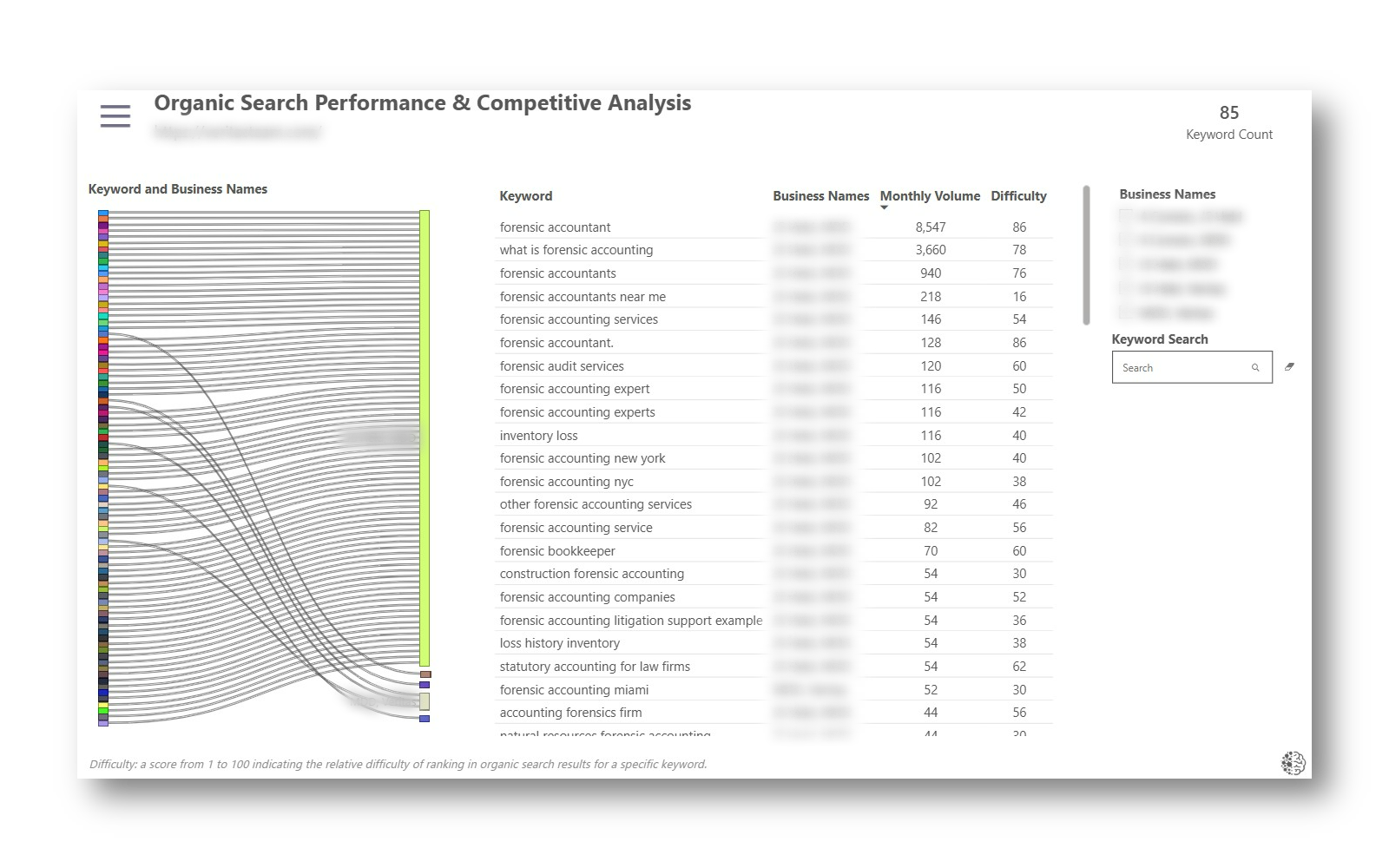
Competitive keyword overlap and business comparison view

1. Keyword Landscape (Market Demand)

Not all keywords carry the same value. Some represent meaningful business opportunity. Others create noise. This layer evaluates:

  • Total keyword footprint
  • Search demand through monthly search volume
  • Distribution of higher-value vs. lower-value keyword opportunities

This defines where the market actually exists β€” not where assumptions say it does.


2. Ranking Position (Visibility Reality)

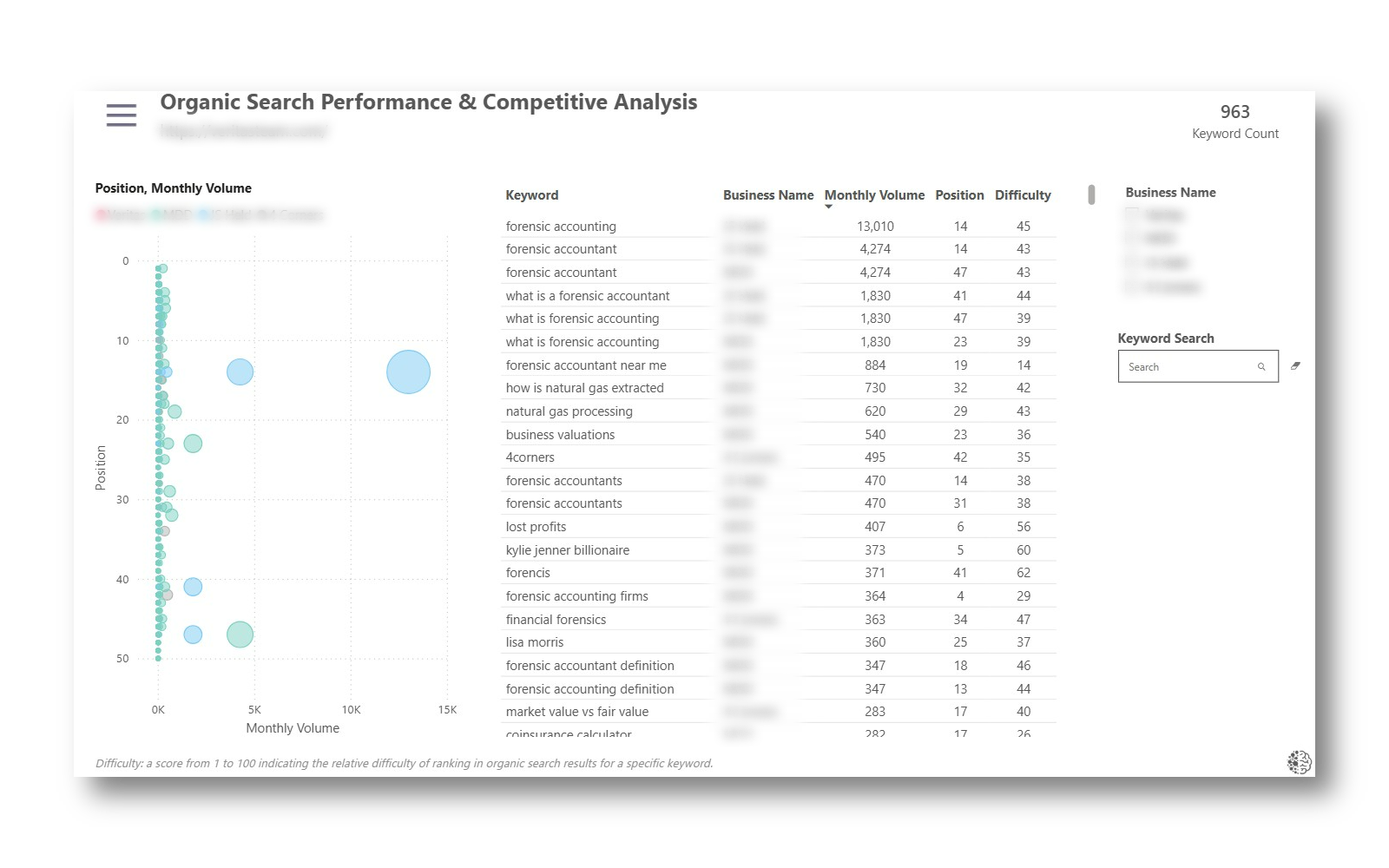
Rankings are not binary. They are positional, and position shapes visibility. This analysis evaluates:

  • Exact ranking positions by keyword
  • Visibility distribution across Top 3, Page 1, and beyond
  • Competitive overlap across the same search terms

This shows how visible you actually are β€” not just whether you appear somewhere in search.


3. Competitive Benchmarking (Who Wins β€” and Why)

SEO is a competitive system. This layer compares your performance directly against the businesses competing for the same search demand.

  • Primary competitor comparison
  • Shared keyword coverage
  • Relative position across overlapping keywords

This reveals where competitors dominate, where you are holding ground, and where meaningful gaps exist.


4. Search Difficulty (Effort vs. Opportunity)

Not all rankings are equally difficult to earn. This category evaluates:

  • Relative keyword difficulty
  • Position compared to difficulty level

This helps clarify whether you are missing achievable opportunities β€” or whether competitors are outperforming you on terms that require stronger authority, content, or relevance.


5. URL-Level Performance (What’s Actually Ranking)

SEO performance happens at the page level β€” not just the domain level. This layer evaluates:

  • Which URLs rank for each keyword
  • Whether the ranking page aligns with search intent
  • How page-level performance compares across competitors

This shows which pages are driving visibility β€” and where content, structure, or targeting gaps may be limiting growth.


6. Opportunity Mapping (Where Growth Comes From)

This is where analysis becomes strategy. This layer identifies:

  • Keywords ranking just outside Page 1
  • Higher-demand, lower-competition opportunities
  • Competitor gaps where your business is not yet visible

This defines where growth can be captured most efficiently.


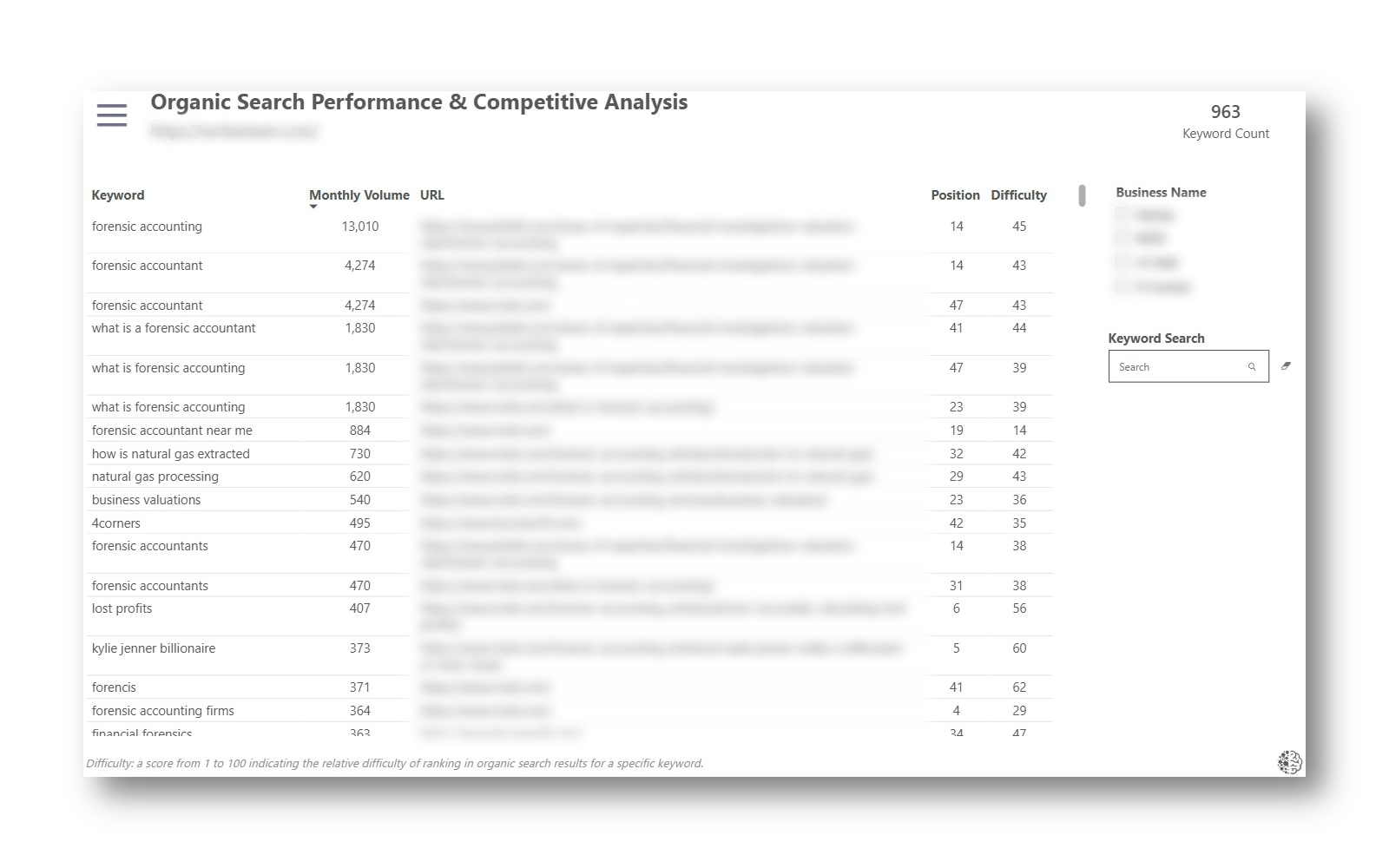
Keyword, monthly volume, URL, position, and difficulty view

7. Executive Scoring & Strategic Clarity

All findings are synthesized into a decision-ready view of the competitive landscape, including:

  • Total keyword coverage
  • Competitive visibility summary
  • Opportunity tiers (High / Medium / Low)
  • Priority recommendations for next action

This turns raw search data into structured direction.


What You’re Actually Seeing

This analysis is built on real competitive signals β€” including:

  • Keyword β†’ what users are searching
  • Business Name β†’ who is ranking
  • Monthly Volume β†’ how much demand exists
  • Position β†’ where visibility currently sits
  • Difficulty β†’ the relative challenge of ranking
  • URL β†’ the specific page earning that visibility

This is not abstract SEO theory. It is real search behavior mapped to real competitive outcomes.


Who This Is For

This analysis is ideal for:

  • Professional services firms competing in search-driven markets
  • Companies investing in SEO without clear competitive visibility
  • Leadership teams needing clarity before scaling content or budget
  • Organizations asking, β€œWhy are competitors outranking us?”

What Makes This Different

  • Competitive-first analysis β€” not isolated SEO metrics
  • Keyword-level visibility mapping grounded in real search demand
  • Page-level insights tied to actual rankings
  • Clear opportunity identification instead of generic recommendations

Why Competitive Visibility Comes First

SEO is not just about improving your site. It is about outperforming others competing for the same market demand.

Without understanding that landscape:

  • Content gets created without clear direction
  • Effort gets spent on lower-impact keywords
  • Real growth opportunities remain hidden

This analysis ensures your strategy is built on where the strongest opportunities actually exist.


What Happens Next

If gaps exist β€” we prioritize and close them. If competitors are winning β€” we identify why and respond strategically. If opportunity is present β€” we move with clarity.

Every decision is grounded in data, visibility, and competitive reality.


Ready to Understand Where You Stand?

If you’d like your own Organic Search Performance & Competitive Analysis β€” let’s talk.

(509) 416-6168

Start My Competitive Analysis β†’

Organic Search Performance & Competitive Analysis FAQs

It's a structured, data-driven evaluation that maps your organic search visibility directly against real competitors, across real search demand.
It evaluates core competitive visibility signals including monthly search volume, ranking positions, keyword difficulty, which URLs rank, intent alignment, and page-level performance across competitors.
The analysis separates higher-value from lower-value keywords by assessing search demand and opportunity, so meaningful business opportunities are distinguished from noise.
Yes β€” it provides exact ranking positions by keyword and visibility distribution across Top 3, Page 1, and beyond.
It maps competitive overlap on the same search terms, compares relative positions across overlapping keywords, highlights competitor gaps, and summarizes competitive visibility.
You get page-level insights showing which URLs rank for each keyword, whether the ranking page aligns with intent, and how page performance compares across competitors.
Yes β€” it evaluates relative keyword difficulty and positions compared to difficulty to clarify achievable opportunities versus terms requiring more authority or relevance.
Findings are synthesized into a decision-ready competitive landscape with opportunity tiers (High/Medium/Low), priority recommendations, and a competitive visibility summary.
It's ideal for professional services firms in search-driven markets, companies investing in SEO without clear competitive visibility, leadership teams planning to scale content or budget, and organizations wondering why competitors outrank them.
To request an Organic Search Performance & Competitive Analysis, contact ANJ Digital at hello@anjdigital.com.